
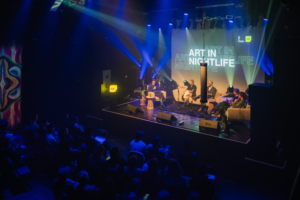
The ADE and VibeLab initiative proposes a global view of nighttime culture, based on 30 indicators. Amsterdam Dance Event and VibeLab have announced the first Nighttime Culture Index (NCI), an innovative research project exploring nighttime culture in six cities on six continents. The dashboard and summary report were presented as part of Amsterdam Dance Event’s 30th anniversary edition.
The research highlights the characteristics of the local scenes in Amsterdam, Lagos, New York, São Paulo, Seoul and Sydney, offering a first-of-its-kind baseline understanding of nighttime culture and how it can be nurtured, supported and celebrated in different regions.
The study was led by VibeLab with the support of local researchers in each city, and explores six main domains: Creative Ecology; Space & Infrastructure; Diversity & Representation; Community & Belonging; Policy & Civic Health; and Sustainability & Environment, covering 30 indicators that analyse the level of cultural offering, accessibility, affordability, diversity and safety as well as the role of local policies.
It is based on desk research, expert interviews, venue visits, quantitative and qualitative audience research including public surveys and focus groups. The findings are based on more than 12,000 club line-ups, 3,000 venues and nearly 30,000 cultural events across all cities. In addition, more than 700 consumers participated in the public survey, with 67 focus groups and 14 expert interviews conducted.
Clubbing represents different ratios of minimum wage across cities
The research shows significant variance between cities in terms of the ratio between the minimum wage and the average price of a club night out. In Sydney, the ratio equals one hour of minimum wage, while in Amsterdam it represents one hour and thirty minutes, in Seoul one hour and seventy minutes, and in New York one hour and eighty minutes. In São Paulo, it constitutes almost nine hours of minimum wage and twenty–five hours in Lagos. The ratio does not include the cost of drinks, transportation and other expenses.
The level of music venue infrastructure differs significantly across cities, with five music venues per million inhabitants in Amsterdam and New York, compared to twelve music venues in Seoul, seven music venues in São Paulo and barely one music venue in Lagos. The Nighttime Culture Index takes into account the availability of alternative DIY spaces and venues as essential contributors to nighttime culture in each city.
According to ADE MD Jan-Willem van de Ven, the accessibility and affordability of clubs are essential to nighttime culture, particularly in those cities where a club night out constitutes a day’s wage and more.
Safety levels vary significantly indoors and outdoors
The research analysed the variance between the perceived level of safety within venues and outside, highlighting that while 73% of respondents in São Paulo felt safe indoors, only 11% felt safe outdoors. Similar patterns were observed in Lagos, with 74% indoor and 20% outdoor safety rates.
Both respondents in São Paulo (70%) and Lagos (84%) associated feelings of unsafety with particular places or even complete avoidance of going out in the last year.
The research also underlines a significant discrepancy between genders, with women feeling significantly less safe when travelling at night. In Amsterdam, while 61% of men felt safe when travelling at night, this number only constituted 28% among women. In Sydney, 75% of men and 48% of women felt safe at night.
Women and gender-diverse artists are significantly under–represented
Across all cities, women and gender diverse artists only comprise 27–32% of line-ups on average and are booked for fewer events, while their male counterparts dominate both in terms of the number of events and overall visibility.
The research also identified a particular issue with diversity in venue ownership, management and staffing, with researchers in five cities finding the representation of diverse groups in leadership roles to be lacking. Both Amsterdam and Seoul researchers added that the absence of diversity in venue staffing was particularly evident in backstage areas.
Grassroots, alternative and queer-led initiatives around the world play a significant role in nurturing inclusive and safe environments for local audiences and communities. However, such initiatives are threatened by the rising costs and reduced capacity for independent nightlife organisers to operate.
Municipalities continue to adopt the business–oriented approach to the nighttime economy
While Sydney, New York, Amsterdam and Seoul have implemented specific nighttime offices or positions, the Nighttime Culture Index reveals that the brief for such roles is largely centred on nighttime business and tourism. Amsterdam’s Nighttime Vision 2021 is the only identified strategy that specifically highlights nighttime culture, with researchers in São Paulo and Seoul suggesting that nighttime culture and its diverse stakeholders should be elevated as a strategic priority for policymakers and that closer collaboration between local government, artists, venues and promoters should be facilitated.
VibeLab co-founder Mirik Milan notes that despite the increasing pressures on the nightlife sector, the global scene continues to deliver outstanding cultural achievements. VibeLab director Asia Pacific Jane Slingo states that the Nighttime Culture Index can become an essential tool to support independent promoters, collectives and artists in engaging with local policymakers.
With its dashboard and summary report, Amsterdam Dance Event and VibeLab have announced their commitment to advancing evidence-based policymaking, contributing to a more comprehensive understanding of nighttime culture and offering a shared baseline for local stakeholders to build on. According to the findings, investment in building inclusive support systems is essential to nurture and sustain nighttime culture.